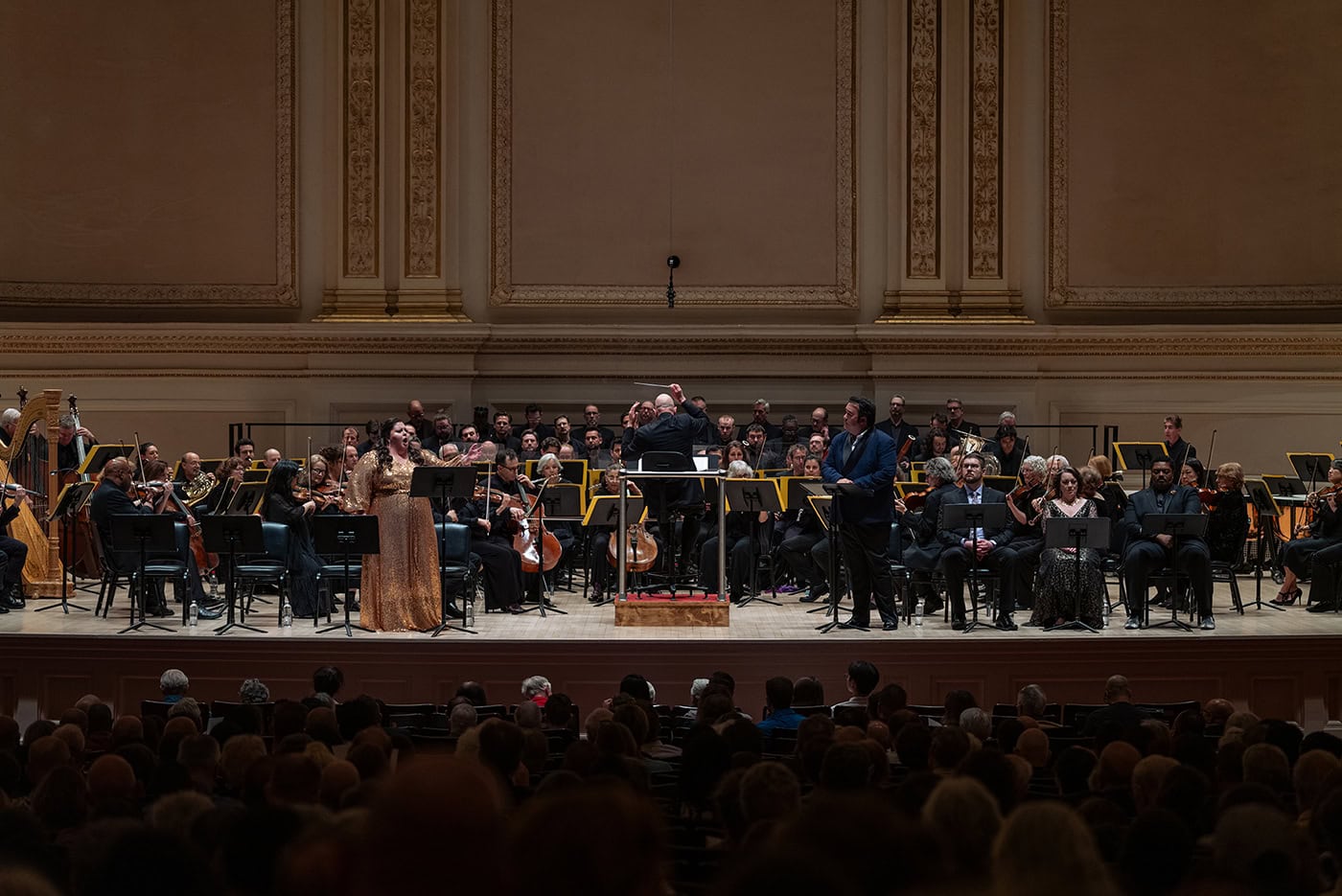
Der Freischütz Reimagined
By Dr. Samuel T. Nemeth
Carl Maria von Weber (1786–1826)
Le Freyschütz
Composed 1817–1821
Arr. Hector Berlioz, 1841
The libretto by Johann Friedrich Kind (1768–1843) was based on a story by Johann August Apel and Friedrich Laun, with french with lyrics translated by Émilien Pacini and Hector Berlioz, and recitatives composed by Berlioz replacing the original work’s spoken dialogue.
Premiere: The original Singspiel was premiered on June 18, 1821, in Berlin at the Königliches Schauspielhaus, conducted by Weber. Berlioz’s version was premiered on June 7, 1841, at the Opéra de Paris, conducted by Pantaléon Battu.
Performance Time: approximately two hours and 40 minutes including one 20-minute intermission
“Oh! If great creative artists could only divine the grand passions their works inspire! If it were only given to them to perceive the enthusiasm of a hundred thousand hearts concentrated in a single heart …” So wrote composer Hector Berlioz in his Mémoires, recalling the groundbreaking impact that the music of German composer Carl Maria von Weber had on him. As Berlioz recounts, his inability to meet Weber during the latter’s stop through Paris on his way to London in February 1826 was tragic, but did not diminish the enthusiasm with which Berlioz received the musical sounds that flowed from Weber’s pen. Unfortunately, Berlioz did not get another chance to meet his newest compositional idol. Weber died only a few months later, but the way that he had inspired Berlioz lived on.
Weber’s influence on Berlioz began two years prior to that episode, though the circumstances under which Weber earned his place among Berlioz’s personal pantheon of composers—which already included Christoph Willibald Gluck (1714–1787) and would soon include Ludwig van Beethoven (1770–1827)—are worth examining. Der Freischütz had received its premiere in Berlin in 1821, though when the opera arrived in Paris a few years later, it took on a different guise. In December 1824, at the Théâtre de l’Odéon, critic Henri Castil-Blaze (1784–1857) presented an “adapted” version of Der Freischütz, complete with cuts, changes to vocal lines, and reordering of material, under the title Robin des bois. The young Berlioz attended multiple performances of Robin and soon became enamored with Weber’s musical writing, though, much later, he criticized Castil-Blaze’s actions in putting the work on stage at the Odéon.
In Chapter 16 of his Mémoires (which Berlioz began to write in earnest early in 1848) while describing his early musical education in Paris in the 1820s, Berlioz writes that Weber “appeared” amidst “the fever of my passion for Gluck and Spontini and of my aversion for the Rossinians and all their works.” Berlioz noted that Castil-Blaze’s adaptation of Freischütz was “an insulting travesty, hacked and mutilated,” far below the later standard that Berlioz held for how performances should steward a composer’s intentions. Berlioz found some aspects of the performance deplorable, but others piqued his interest. He admitted his surprise at how the work enraptured him, noting that “in my exclusive worship of classical opera, I had been intolerantly prepared to reject the new style; but to my surprise it delighted me, garbled though it was by incomplete or crude performance. Even in this ravaged form there was a wild fragrance, a delicious freshness in the score that intoxicated me … I never missed a performance, and soon knew Freischütz, or all of it that was given there [at the Odéon], by heart.”
Weber’s music, even if not performed entirely as the composer intended, opened a new realm to Berlioz. Similarly, as Kern Holoman writes in his biography of Berlioz, the young Hector “reveled in the first genuinely Romantic music to reach his ear.” Similarly, David Cairns describes Berlioz’s witness to Robin des bois as his “introduction to German musical Romanticism.”
But at the same time, Robin des bois exposed Berlioz to the darker side of commercial success and to the prevailing belief that composers’ music could be freely adapted by others seeking to profit off of a composer’s creativity and innovation. As Berlioz notes in the Mémoires, perhaps with a touch of retrospective malice, Castil-Blaze raked in handsome sums from the great number of performances and from publication of the adaptation’s orchestral and vocal scores. In contrast, Weber, much maligned, saw none of the proceeds, and the score for the original Freischütz remained unpublished. This episode, both as it occurred in 1824 and as Berlioz described it much later, influenced his priorities when preparing for a French-language production of Der Freischütz—as Le Freyschütz—at the Paris Opéra in 1841.
When Léon Pillet, director of the Opéra, approached Berlioz about his interest in the project, Berlioz knew that the task of mounting Le Freyschütz posed a logistical, cultural, and musical challenge. In its original format, Freischütz juxtaposed its solo arias, group numbers, and choruses with unaccompanied spoken dialogue, which was forbidden on stage at the Opéra. Productions needed to utilize the operatic mainstay of recitative, with its “speech-singing” texture, to advance the plot. Berlioz’s task, therefore, was to compose more than a dozen recitatives for the production, a job he was hesitant to take on because it meant that music composed by someone other than Weber would be included in the production. Ultimately, Berlioz’s desire to steward the intentions of one of his compositional idols won out. Rather than risk yet another mutilation of the score by another composer who, in his words in the Mémoires, would “certainly [be] less dedicated to the glorification of [Weber’s] masterpiece,” Berlioz agreed to the task on the condition that the opera would be presented in full, without the cuts of a Castilblazade.
That same impulse guided Berlioz as he sought a solution for the obligatory second-act ballet in the production. Rather than acquiesce to Pillet’s suggestion that Berlioz import his own music, specifically the “Ball” from the Symphonie fantastique (1830) and the music from the Capulets’s ball in Roméo et Juliette (1839), Berlioz deftly worked out a way to ensure that more of Weber’s music would be heard. He orchestrated Weber’s existing piano composition, Aufforderung zum Tanz (Invitation to the Dance), renaming it, in French, Invitation à la valse. The piece became a successful standalone work, with Berlioz conducting it several times in the remaining two-plus decades of his life. Additionally, Berlioz incorporated dance tunes from Weber’s operas Oberon and Preciosa to ensure not only that the music for the ballet fit the required length, but also that, apart from the new recitatives (for which Berlioz attempted to remain anonymous as the composer), all of the music for the production was composed by Weber himself. Despite Berlioz’s initial hesitations, Le Freyschütz was a success, going on to receive more than 60 performances in its initial run.
In this evening’s performance, swirling strings, peaceful and triumphant horns, and skillfully-deployed woodwind and brass instruments, which frequently venture into the extreme upper and lower ends of their ranges, all contribute to the duality of the rustic and supernatural soundscapes of Le Freyschütz. Music from the overture often prefigures other moments from later in the opera. For example, the stormy Allegro section of the overture, followed by the eruption of the cascading string melody, is heard prominently in Act I, while Max is contemplating his misfortune (“Ah! trop longtemps de mes souffrances”) and is first being stalked in the shadows by the “Black Huntsman,” Samiel.
In Max’s aria, we do not hear the burst of the cascading string melody from the overture, though Max does sing the snippets of the overture’s Allegro melody that is first played by the clarinets. Later, in the Act II finale, the “Wolf’s Glen” scene—in French beginning with “L’herbe tombe en pâlissant”—at the moment when Kaspar (in the French, Gaspard) successfully casts the sixth magic bullet, the eruption of the string cascade that one expected in Max’s earlier aria is finally heard, as if all of the music between his aria in Act I and the Act II finale was slowly building toward that sonic explosion.
As John Warrack writes in The Cambridge Berlioz Encyclopedia, Berlioz’s admiration for Weber’s music was built on Weber’s “revolutionary mastery of the orchestra. Its appeal to Berlioz was the essentially Romantic example of making orchestral colour a vital aspect of the means of expression.” Berlioz recognized in Weber someone who knew how to utilize the sonic resources of the orchestra in a novel way, one that enhanced the on-stage drama and Weber’s musical depictions of characters.
Perhaps no written reception by Berlioz so clearly epitomizes his admiration for Weber’s orchestration than Berlioz’s entry on the clarinet in his Grand traité d’instrumentation et d’orchestration modernes (Treatise on Instrumentation and Orchestration). Describing the moment in the overture, following the E-flat major horn blasts that will later announce Max’s arrival at the Wolf’s Glen, the floating clarinet part that emerges, high above the active tremolo string texture, perfectly evokes Max’s beloved Agathe. Berlioz rhetorically asks about this “dreamy” phrase: “Is this not the lonely virgin, the huntsman’s fair bride, her eyes upturned to heaven, mingling her passionate plaint with the roar of the storm-wracked forest? … Oh Weber!!!” To meet the challenge of stewarding Weber’s true compositional intentions at the Opéra in June 1841, Berlioz’s rapture at the purity of the clarinet might help us to understand why Berlioz felt that he alone was the man for the job.
Dr. Nemeth teaches courses in music history and culture in the Performing Arts Department at Ohio Wesleyan University.