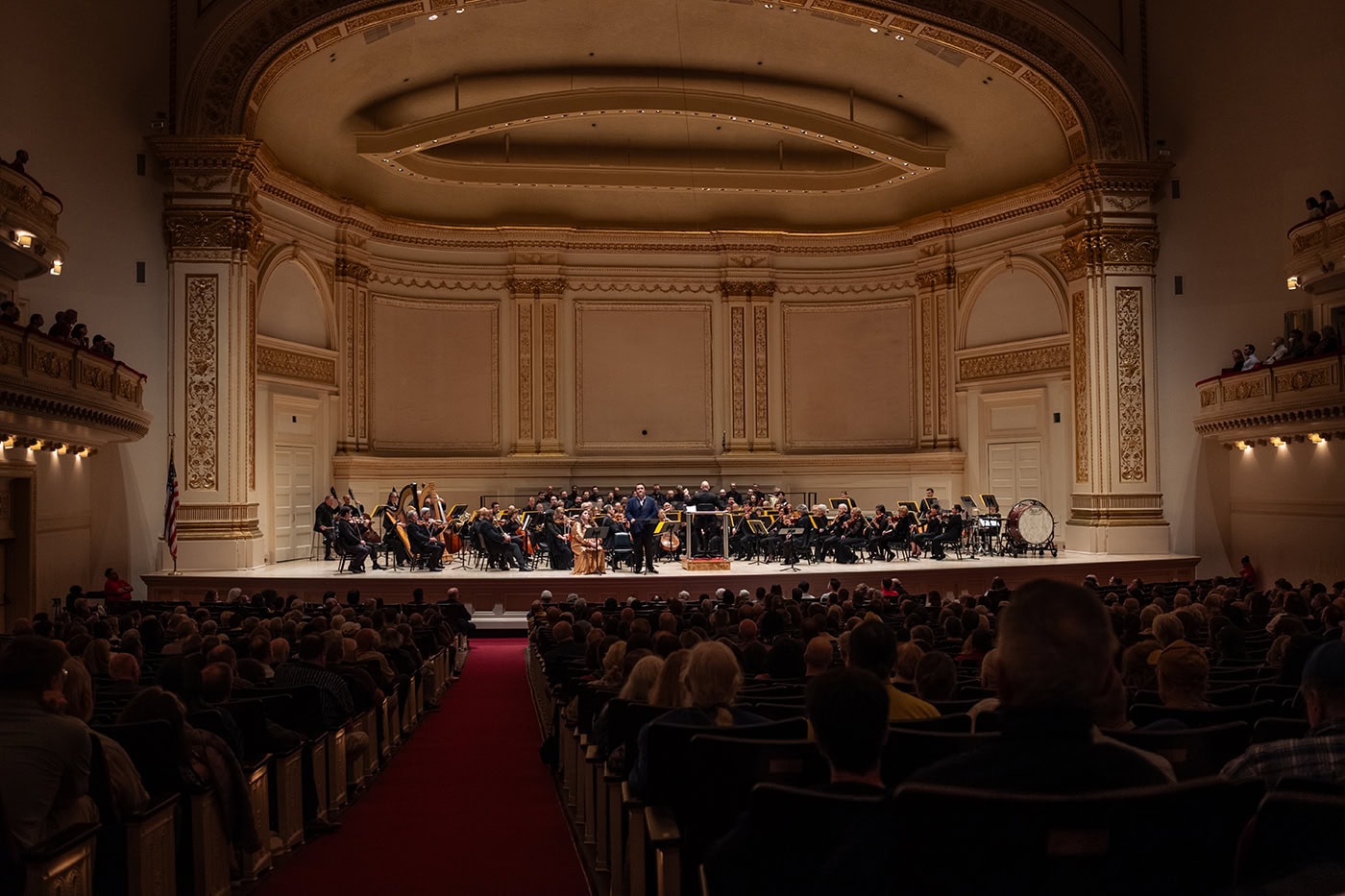
Forging an American Musical Identity
By Daniel Goldmark
Dudley Buck
Born March 10, 1839, in Hartford, Connecticut
Died October 6, 1909, in West Orange, New Jersey
Festival Overture on the American National Air
Composed 1879
Premiered July 4, 1879 at Manhattan Beach, Coney Island, New York
Performance Time: Approximately 7 minutes
A native of Hartford, Connecticut, Dudley Buck taught himself to play the flute by the age of 12, and quickly moved on to the organ after his parents realized they could not dissuade him from a career in music. After two years of music study at Trinity College in Hartford, he went at age 19 to Leipzig, learning from Ernst Richter, Moritz Hauptmann, and Ignaz Moscheles, among others, and was classmates with Edvard Grieg. He continued his organ studies in Dresden and then Paris before returning to Hartford in 1862, where he made a career as a touring concert organist. Buck eventually ended up as the assistant conductor for the Theodore Thomas Orchestra in New York, following a two-year stay in Chicago that ended abruptly after the Great Chicago Fire of 1871, and then several years in Boston, where he taught at the New England Conservatory.
Buck’s name was catapulted into public recognition by his involvement in one of the biggest concerts then ever mounted. Bandleader Patrick Gilmore had already organized the National Peace Jubilee in 1869 in celebration of the end of the American Civil War, which involved more than 1,000 instrumentalists and more than 10,000 singers. He followed this with an even more gargantuan event, the World’s Peace Jubilee and International Musical Festival in Boston’s Back Bay in June 1872, again with close to 1,000 instrumentalists and 17,282 choristers from 165 choral groups, for which Buck was commissioned to write the words and music for the event’s “Festival Hymn.” Less than four years passed before he received the commission for the Philadelphia Centennial Celebration, writing The Centennial Meditation of Columbia, with words by Sidney Lanier. Assisted by the organ inside the Centennial Festival’s main building, which could be heard through open windows, and with the support of the 1,000 singers present, Buck’s Meditation was a huge success, so much so that The New York Times reviewer praised his cantata.
The piece on tonight’s program was another commission from Gilmore, in this case to celebrate the Fourth of July by using “The Star-Spangled Banner.” Buck had already created one piece using the theme of the “Banner”: his Concert Variations on “The Star-Spangled Banner” for organ, composed and first performed on the heels of the Civil War, in 1866. Theme and variation sets were extraordinarily popular in the 19th century, and made use of popular songs, folk songs, national themes, and just about anything else melodic and en vogue. For instance, one of the first American composers of the 19th century, Bohemian émigré Anthony Philip Heinrich (1781–1861), wrote the ultimate—bordering on outrageous—exploration a folk melody with his Yankee Doodleiad (1820), an extraordinary theme and variations set on “Yankee Doodle” (another song competing with “Hail Columbia” as the unofficial anthem of the US), including an entire statement of the tune in which the violinist is instructed to play every note with a trill. Not everyone was a fan of variation forms; a letter to the editor of Dwight’s Journal of Music in 1853 from the point of view of the song “Yankee Doodle” gives a comic reading of the situation; in part: “Why is it, sir, when one of your … bewhiskered fancy fiddlers, has tickled his audience with his capering fingers, till they call him out again—why is it that I am to be dragged out and tortured for an encore! What have I done to be served up so—‘Yankee Doodle, with variations!’ Sir, I am not played—I am shamefully played with, smothered in ‘ornaments,’ strangled, bedeviled, fiddle-de-deed to death! Sir, I do not deserve this … Yes, sir, me—Yankee Doodle—the National Anthem of this great Republic—me they put through such shameful antics, as if I were a dancing dog, or an organ-grinder’s monkey!”
Buck provides in the Festival Overture (1879) a novel group of variations on the familiar theme (which, incidentally, wouldn’t be “officially” adopted as the national anthem by the US government until 1931; this is why Buck refers to the “Banner” as the “American National Air”). In addition to the original orchestration, Patrick Gilmore used a band arrangement of the Overture in numerous summer performances at Coney Island; the piece was also taken on the road throughout the US and Europe by Texas-born conductor Frank Van der Stucken, who would invite audiences (via a note in the printed program) to sing a single verse of the anthem at the appointed moment. It was during one of Van der Stucken’s tours that Buck’s Overture became a representative work at the “American Concert” given at the Exposition Universelle in Paris on July 12, 1889 at the Trocadero Palace, along with works by Foote, Chadwick, Paine, and MacDowell.
Harry Thacker Burleigh
Born December 2, 1866, in Erie, Pennsylvania
Died September 12, 1949, in Stamford, Connecticut
Go Down, Moses
Orchestral arrangement composed in 1917
Performance Time: Approximately 3 minutes
Behold that Star
Orchestral arrangement composed in 1916
Performance Time: Approximately 5 minutes
Swing Low, Sweet Chariot
Orchestral arrangement composed in 1917
Performance Time: Approximately 3 minutes
Harry Thacker Burleigh’s fame as a singer and composer persists to this day, in part through the ongoing popularity of the spirituals he arranged, and also as perhaps the first Black composer to achieve national awareness. Burleigh was born in Erie, Pennsylvania. His mother was likely his first music teacher, from whom he learned both spirituals and art songs. He was performing publicly as a singer by his late teens, both in choirs and as a soloist, for church services and secular concerts. He received a full, four-year scholarship to the National Conservatory of Music in New York, by which point he was quite well-known as a soloist in Erie and other major cities nearby (Cleveland and Buffalo); his fame would skyrocket in New York. Antonín Dvořák joined the Conservatory as its director in the fall of 1892; he quickly became acquainted with Burleigh. While he was not a composition student of Dvořák’s (although Burleigh did study harmony with Dvořák’s student Rubin Goldmark), Burleigh spent much time with Dvořák and his family, famously singing spirituals and plantation songs to Dvořák at the same time that the composer was formulating what would become his Ninth Symphony, which includes clear echoes of the songs Burleigh made available to him. In this way, Burleigh inadvertently became a central part of the heated debate regarding what constituted American music.
In 1894, the same year that Dvořák’s symphony premiered, Burleigh auditioned with 59 other singers for the position of baritone soloist at St. George’s Protestant Episcopal congregation. Each hopeful performed behind a screen, and Burleigh ultimately earned the position, to the dismay of some congregants, who couldn’t imagine a person of color in such a prominent post, and to the delight of others, including industrialist J.P. Morgan, who held a leadership role in the church. Burleigh’s fame as a singer grew inestimably with this new job; his Palm Sunday performances of Jean Baptiste Fauré’s “The Palms” became an annual tradition that he repeated without fail from 1895 until his retirement in 1946. He had another regular position, held for 25 years, as one of the two baritones in the choir at Temple Emanu-El, the major Reform synagogue in New York.
As a composer he became famous for his art songs—both individual and song cycles—beginning in 1914. No less a figure than John McCormack, the internationally renowned tenor, featured several of Burleigh’s songs in his recitals; his works soon became de rigueur for vocalists. While Burleigh had also published his own versions of traditional spirituals as far back as 1901, the major turning point occurred with his arrangement of “Deep River” in 1916, which was adopted by a bevy of soloists around
the country and became one of his signature works. His biographer Jean Snyder suggests that the success of “Deep River” corresponds in part with the custom of ending a program of solo vocal works with a grouping of spirituals, a practice that persists to this day. These songs entered the mainstream repertoire very quickly; by December 1917, Burleigh’s arrangements of spirituals (including “Deep River”) were heard here, in Carnegie Hall, at an anniversary concert for the Musical Art Society, conducted by Frank Damrosch. Concert performances of spirituals had formerly been heard only in choral or ensemble arrangements, not as works for solo performers. Musicologist Eileen Southern noted that “Burleigh’s achievement made available to concert singers for the first time Negro spirituals set in the manner of art songs.” Burleigh would go on to create dozens upon dozens of spiritual arrangements—for solo voice and in various choral arrangements—in addition to the many art songs he wrote throughout his life. Two of the songs that will be heard tonight, “Go Down, Moses” and “Swing Low, Sweet Chariot,” were published in his first wave of solo spirituals in 1917; “Behold that Star!” (published in 1928) is one of several later works in the genre.
Richard Wagner
Born May 22, 1813, in Leipzig, Germany
Died February 13, 1883, in Venice, Italy
Großer Festmarsch (American Centennial March)
Composed in 1876
Premiered on May 10, 1876 in Philadelphia at Fairmount Park in Philadelphia, PA, conducted by Theodore Thomas
Performance Time: Approximately 12 minutes
The earliest piece on our program is probably the most famous—or infamous, depending on who you ask—and was created to celebrate the first hundred years of the country’s existence. The Philadelphia Centennial Exposition or (officially, by act of Congress) the International Exhibition of Arts, Manufactures, and Products of the Soil and Mine had its opening jubilee on May 10, 1876, in Fairmount Park in Philadelphia, Pennsylvania. The exposition had something for everyone, including the world’s largest soda fountain, and new (to the general public) and strange items like bananas and Heinz tomato ketchup. The hand and torch of Bartholdi and Eiffel’s new giant sculpture of Liberty Enlightening the World—which has been intended for the nation’s centennial—were put on display, as the rest of the statue was not yet completed.
To help the festivities begin with a bang, the organizers planned a public event that would include speeches from dignitaries—including an official welcome from President (and Civil War hero) Ulysses S. Grant—as well as performances of several pieces of music. The entire event was organized by the Women’s Centennial Committee, presided over by Elizabeth Duane Gillespie, a great-granddaughter of Benjamin Franklin and longtime friend of Theodore Thomas, perhaps the most famous conductor in the country, who was offered the musical directorship of the opening ceremonies. Throughout his life, Thomas was an advocate for composers in America, programming works by more than 150 American-born (or immigrants to America) composers during his time with the Brooklyn Philharmonic, the New York Philharmonic, the Chicago Orchestra, or touring the county leading the Theodore Thomas Orchestra.
For the opening, Thomas commissioned works by two American composers, as well as the man he felt was, in his words, “the most eminent living composer in the world,” Richard Wagner. Thomas was well-known as one of the major advocates in the US for Wagner’s operas, which were still largely unknown to most music fans. Wagner asked for—and received—the extraordinary sum of $5,000 for the work, paid in advance. (This amount, as Douglas Shadle observes, was 50 times that which George Bristow, who closes our program, received as commission for an entire symphony, Arcadian, just four years earlier). Whether or not Wagner particularly relished this commission is hazy; Cosima Wagner noted in her diary in late December 1875: “R. feels great disgust towards the composition for America; it is unworthy of him!”
Fifty cents got you in to the opening day of the celebration; officials reported the final count was 186,672 people, more than half of whom got in free. A wide variety of luminaires, from J.P. Morgan to Henry Wadsworth Longfellow to Frederick Douglass showed up, all presided over by President Grant, along with foreign dignitaries including Emperor Pedro II and Empress Theresa of Brazil. The musical programming began with no fewer than 18 national airs performed in succession, beginning with “The Washington March,” followed by the anthems of European and South American countries, and rounded off by “Hail Columbia,” then the de facto national anthem of the US. Finally, as President Grant first sat upon the stage, Wagner’s Grand Festival March for the Inauguration of the Hundredth Anniversary Commemoration of the American Declaration of Independence was heard for the first time … almost. With so many people present and no way to direct the sounds on the open bandstand, few of those in attendance heard the music.
Then there was the music itself. The reviewer from Dwight’s Journal apparently loved the work, hearing echoes of the majesty of Meistersinger and the poetry of Tristan, ultimately gushing, “No praise which has been lavished upon this noble composition overstates its merit, and we are greatly disappointed in the taste of our countrymen if it does not soon become one of the most popular of Thomas’s concert pieces.” This was in opposition to the Times reviewer, who decried, “This achievement did not inspire very lively admiration. It is altogether devoid of the pomp and circumstance which should characterize an achievement of this sort, and all its beauties … do not make amends for the lack of thought which has made recourse to scholastic treatment of a single theme necessary throughout the 33 pages of the work.” Some were bothered by the fact that an American had not been chosen to open the festival. John Rose Green Hassard, the Tribune’s critic, seemed quite happy that the tune did NOT have any identifiable national tunes woven within; he stated, “We might have had to resort to ‘Yankee Doodle’ or ‘Hail Columbia’ from the marine band.” The work ultimately did not enter the repertoire as Thomas had hoped—no matter how often he performed it—and instead became a curiosity, as did the other two works specially commissioned\ for that morning: a hymn by John Greenleaf Whittier set to music by John Knowles Paine, and the Centennial Meditation of Columbia, with words by Sidney Lanier and music by well-known organist and composer Dudley Buck.
George Frederick Bristow
Born December 19, 1825, in Brooklyn, New York
Died December 13, 1898, in New York, New York
Symphony No. 5, Op. 62, “Niagara”
Composed in 1893
Text by Charles Walker Lord
Premiered on April 11, 1898 in New York City at Carnegie Hall, conducted by George Frederick Bristow
Performance Time: Approximately 90 minutes
The final work on the program is perhaps the most momentous, in that this work was last performed in full in this very space 128 years ago, the night of its premiere. By the time audiences heard his “Niagara” symphony, George Frederick Bristow was at the end of a storied career as a performer, composer, teacher, and—above all—advocate for music in practically all its forms, but especially music for and by Americans. Born in Brooklyn, New York, he was the child of two English immigrants, William and Mary Ann; his father was known in Brooklyn for his musical abilities, and became young George’s first teacher, although he had other illustrious teachers, including violin lessons with Ole Bull when the latter was touring the US. Bristow worked as a violinist and pianist in both groups and as a soloist, as well as taking part in larger ensembles, such as when he played violin in the group that accompanied Jenny Lind during her concert stops in New York City in 1850 and 1851.
While he was still a teenager Bristow began composing, and eventually wrote extensively in vocal music, both sacred and secular, including his very successful oratorio, Daniel (1867), along with chamber music and keyboard music. He joined the first violin section of the Philharmonic Society of New York at age 18 and was an active member for more than 35 years. He also had considerable experience as a choral conductor, leading the New York Harmonic Society, an amateur choral ensemble, among several others.
Bristow became a key figure in a debate in the mid-1850s between critics, musicians, and composers about what music should be promoted by local orchestras in the US: compositions by Americans or compositions by Europeans, particularly Germans. Like many others, he felt that the Philharmonic Society undervalued or downright excluded American composers, although much of the rhetoric boiled down to fears about immigration. While Bristow’s compositional style always drew strongly from his European forebears, following the brouhaha the subjects for many of his works skewed toward explicitly American topics, including his comic opera Rip Van Winkle (1855, based on the Washington Irving story, and considered the first opera on American themes), the overtures Columbus (1861) and Jibbenainosay (1889) (the latter based on a 50-yearold American novel combining themes of the gothic and the frontier—two very popular 19th century tropes), and of course “Niagara.” Not long after this public debate, Bristow became a music teacher in the New York Public School system in 1854, and ended up writing several music methods and teaching guides.
Bristow began work on his fifth and final symphony near the end of his career, drawing on a poem by Charles Walker Lord, a schoolteacher and acquaintance. As noted by his biographer, Katherine Preston, the poem (written in the early 1870s) was nostalgic in its view of Niagara Falls, which had lost lustre in the latter part of the century as a point of national pride; the resulting symphony also looks back stylistically to earlier musical forms (including, as others have noted, Beethoven’s Ninth Symphony), as well as drawing on familiar older tunes, including the Doxology / “Old Hundredth” and the “Hallelujah” chorus from Handel’s Messiah.
Bristow finished the symphony in the spring of 1893, meaning that his sonic portrait of America predated Dvořák’s by at least a half a year—but “Niagara” did not receive its premiere for almost five years, to be put on by the Manuscript Society of New York, including a chorus of 200, vocal soloists, and the Seidl Grand Orchestra, to be conducted by Anton Seidl himself. Tragedy struck two weeks before the concert, when Seidl died at age 47. The show did ultimately go on, on April 11, 1898, with Bristow conducting his own work here at Carnegie Hall, but with practically no mention: no reviews of the concert have been found, and only a single newspaper notice, recently discovered, indicates the event took place at all. Bristow died doing what he loved—teaching in a music classroom—exactly eight months later.