Forging an American Musical Identity
By Leon Botstein
The history of classical music for the concert hall and the opera stage in the US mirrors the complex crosscurrents and tensions that have characterized the history of the nation since its founding in 1776.
The “New World,” the land on which the US was established, was neither new nor uninhabited when Europeans arrived between the end of the 15th century and transformed 13 English colonies into a new nation during the last decades of the 18th. The English, French, and Spanish arrived in the Western Hemisphere as conquerors and colonists. They encountered diverse and thriving Indigenous populations and their cultures. Estimates vary, but there were probably 50 million Indigenous people living in North America when the European migration began. Disease and violent conflict with the European newcomers radically reduced that number by the end of the 19th century by an astonishing 90 percent.
The European settlement of North America also brought with it the slave trade from Africa. Black slaves made up one fifth of the population in 1776. By 1790, there were 700,000 Black slaves, 18 percent of the new nation’s population. When the Civil War broke out in 1860, the country had four million Black slaves and 500,000 free Black Americans.
We need to be reminded of these facts since they tend to be overlooked and forgotten when the history of the US is told. We prefer to focus on how the US, before and after the Civil War, grew dramatically as a nation of immigrants, first from the British Isles then from continental Europe, particularly German-speaking Europe. A European cultural heritage maintained an allure and exerted a powerful influence not only on immigrants but on their descendants over several generations. At the same time, as Alexis de Tocqueville observed in the 1830s, Americans with roots in Europe quickly developed their own habits, mores, patriotic sensibilities, and pride in qualities they deemed unique, ranging from “rugged individualism” and “self-reliance,” to a distinct commitment to democratic values and practices, eloquently articulated by Abraham Lincoln in his Gettysburg Address, as government “of the people, by the people, for the people.”
Nevertheless, the European heritage continued, throughout the 19th century, to loom large in the consciousness of Americans, bolstered by successive waves of immigrants and continuing ties to the “Old World.” It should come therefore as no surprise that for the centennial celebration of the founding of the American Republic in 1876, during the presidency of Ulysses S. Grant, a lavish commission was given to Richard Wagner, arguably then the most famous living European composer, to write a work celebrating the historic milestone of America’s founding. In his outstanding notes for this concert, Daniel Goldmark notes that those who organized the Wagner commission also sought to promote music written by American composers. However, most American composers who achieved prominence during the years between the end of the Civil War and the US’ entrance into World War I went to Europe for their training. This includes John Knowles Paine (for whom Wagner was anathema), Horatio Parker, George Chadwick, and Edward MacDowell, though not George Frederick Bristow and Harry T. Burleigh.
Nonetheless, although he was born in America and made his career here, George Frederick Bristow remained indebted, as Goldmark points out, in his compositions to European practices and models. The concert repertoire in New York, Boston, and Philadelphia during his lifetime was nearly exclusively European. At the same time, Bristow and his contemporary American-born composers sought to find ways to distinguish themselves from the European and evoke, through music, the spirit, populace, landscape, and history of the nation. That was certainly true for Dudley Buck, whose overture on what has become our national anthem opens the concert. Bristow was a tireless and outspoken advocate of American composers and musicians. His career was an astonishing combination of performance, composition, teaching, and organizational leadership.
Bristow’s efforts notwithstanding, Americans, in terms of concert music and opera, remained deferential to Europe for the duration of the 19th century. When Carnegie Hall opened in 1891, Tchaikovsky was invited from Russia to mark its debut. When a national conservatory was founded in New York in 1892, the Czech composer Antonín Dvořák was recruited to lead it. But Dvořák’s arrival resulted in the unexpected. Dvořák admonished Americans to look to their own unique history and cultural resources, particularly those of the Indigenous nations and the descendants of slaves. He argued against a reliance on European models. In his view, the two facets of American history—its Indigenous cultural heritage and that of Black Americans—could contribute to making American music original and distinct. Harry T. Burleigh was one of Dvořák’s protégés. Burleigh, Will Marion Cook, William Arms Fisher, Rubin Goldmark (who taught Aaron Copland and George Gershwin), and Arthur Farwell (who did not study with Dvořák and trained in part in Europe to become the leading advocate of the Indigenous American heritage) were each influenced by Dvořák’s advocacy of uniquely American sources in music. Dvořák’s admonition was prescient and inspired the flowering of a distinct American repertoire during the 20th century that has continued in the 21st.
With Buck and Bristow’s music, this concert by the ASO celebrates an overlooked dimension in the history of American music, one more directly reliant on European trends and that saw its heyday during the last quarter of the 19th century. The centennial celebrations, America’s industrial expansion and a triumphalism linked to the popular but controversial myth of “manifest destiny” that morally justified America’s superiority in the decades prior to (and after) Dvořák’s arrival in the early 1890s encouraged a highly charged romantic musical expressiveness. This concert features the first complete performance (and only the second performance of any sort) of the last major composition by Bristow, who had established himself as the leading American symphonic composer before the subsequent generation of Paine (who was 14 years younger) and Chadwick (who was nearly 30 years younger). Bristow sought a synthesis between an American sensibility and European precedents in compositional practice, particularly those of Beethoven, Mendelssohn, and Schumann. The “Niagara” symphony on the program is therefore more a valedictory to the 19th century than a harbinger of the culture and temperament of the 20th century. It is a monument in music to a nationalist American musical culture more akin to a post 1848 European musical late romantic nationalism best represented by Wagner. The American version of that movement in music is now largely forgotten and ignored. Only Burleigh’s music points to the novel differentiated cultural trends anticipated by Dvořák, (including experimental modernism), that would prevail in American music during the 20th century.
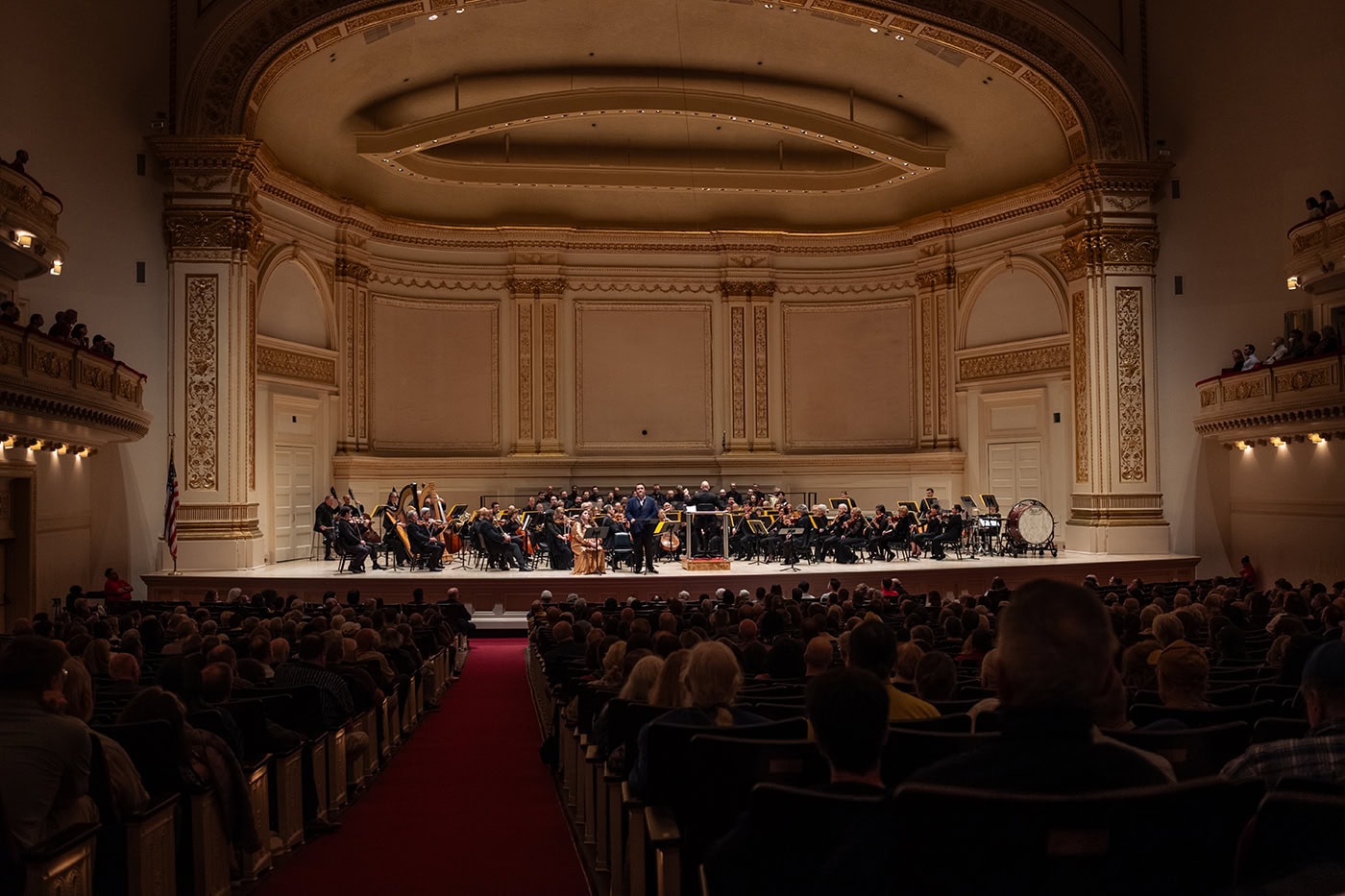
This program of Bristow, Burleigh, and a rarely performed work by Wagner was designed also to pay homage to the history and mission of the American Symphony Orchestra. The ASO was founded in 1962 by Leopold Stokowski. Stokowski was a consummate showman, a fine organist and legendary conductor who made his career on the podium as an advocate of contemporary music, the art of transcription, brilliant, freewheeling interpretations, and a unique and lush orchestral sound. He sought to render past repertoire contemporary and reimagine classical music for a growing mass audience in an era of new technologies of sound reproduction and the moving image with sound. His most enduring achievement may be Fantasia, the Disney film from 1940 made up of animated visual narratives set to iconic works from the classical repertoire. Fantasia was conceived and conducted by Stokowski, narrated by Deems Taylor, an American composer who had achieved, briefly, considerable success (and whose operas were performed at the Metropolitan Opera). Taylor was actually more famous as a popular commentator and proselytizer of music.
Stokowski emigrated in 1905 to the US from England to take a post at St. Bartholomew’s in New York. He quickly became an American idol and icon. In 1962, the octogenarian Stokowski sought to advance the cause of classical music in America by founding an orchestra, resident in Carnegie Hall (which the New York Philharmonic left for the then brand-new Lincoln Center), made up exclusively by American musicians, mostly young and trained in the US. Stokowski’s most memorable ASO concert was the posthumous premiere of Charles Ives’s Fourth Symphony in 1965. Stokowski’s mission for the ASO was to offer concerts at affordable prices, feature less well-known repertoire, past and present (particularly from the Western Hemisphere), and perform new music. In the years since his retirement from the ASO in 1972, when he returned to England, the ASO has sought to sustain his vision. This concert pays homage to Stokowski. Its program emulates his leadership in contribution to the life of American music.