Requiem & Revelation
By Leon Botstein
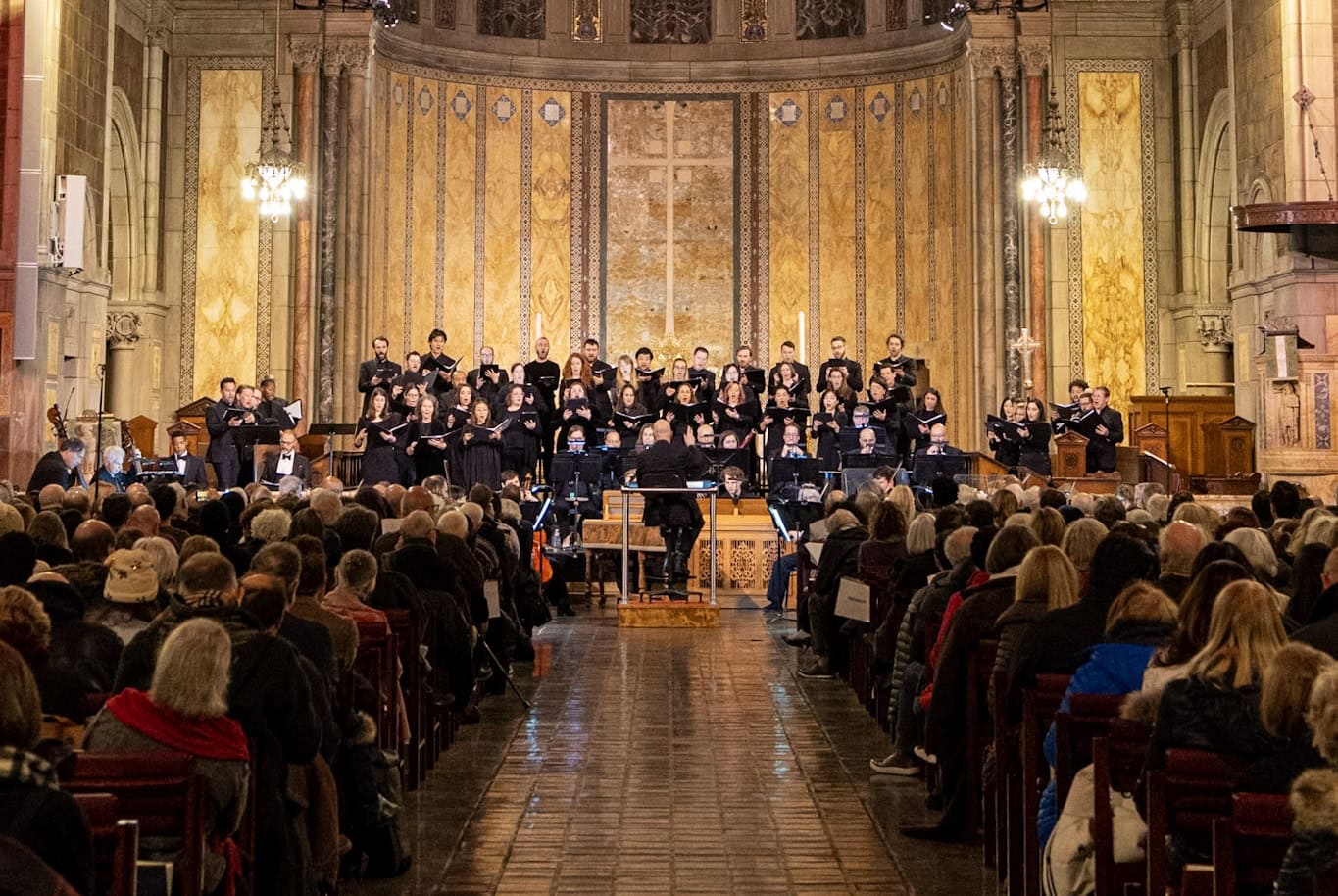
Today’s concert at St. Bartholomew’s brings to light, with live performance, two sacred works from the first half of the nineteenth century. The earlier work—the Cherubini Requiem from 1816 closes our concert. However, it provides a foundation for understanding the character and place of sacred music during the Romantic era.
The conventional account of the early nineteenth century argues that the so-called Age of Enlightenment or Age of Reason came to an end during the Reign of Terror of the French Revolution, the subsequent rise of Napoleon and his reinvention of monarchy as a distinctly imperial enterprise. There seemed to be no question that the ancien régime, the political system before the Revolution, had come to an end. But its demise turned out to be temporary and partial. Napoleon was a symbol of a new age in which an individual might transcend the limitations of birth and rise to a position of power. He not only became a monarch, but invented a new aristocracy and ruled over a vast territory acquired by conquest. The same unprecedented career characterized his sometime associate and rival, Marshal Jean-Baptiste Bernadotte, the French commoner who ascended the Swedish throne through fame achieved by military prowess.It could be argued that these self-made men simply exploited old hierarchies and gave only lip service to the revolutionary ideas of equality, fraternity and liberty. Yet they paved the way politically for scientific and technological progress, industrialization and democratization during the nineteenth century.
The terror of the Napoleonic Wars and the repressive restoration that dominated Europe between 1815 and 1848 led to several shifts in cultural taste. Given the rapid economic development that began in England in the mid-eighteenth century and continued throughout the first half of the nineteenth century, it comes as no surprise that there was a profound expansion of literacy and cultural consumption in the rapidly expanding major cities of Europe. Modern nationalism developed out of a reaction to Napoleon’s triumphs.
In contrast to the eighteenth century during which the secular skepticism of Voltaire predominated, the early nineteenth century witnessed an intense interest in human subjectivity and sentiment, in spirituality, metaphysics and even the gothic and occult. The religious experience enjoyed a revival as confidence dwindled in the faith that reason could be the governor of human behavior. Luigi Cherubini (1760-1842) was an Italian who made his career in France initially under the patronage of the Bourbon monarchy. He maneuvered deftly through the various stages of the French Revolution and Napoleonic rule only to emerge after 1815 as the official representative of music during the Bourbon restoration of Louis XVIII. This Requiem was written to commemorate the reburial of the Bourbon monarchs, which itself was an event designed to ritually mark the defeat of the Revolution.
The ironic fact that decades earlier Cherubini had written music to celebrate the execution of Louis XVI suggests the elusive power and ambiguity of music as a form of life and communication. Arthur Schopenhauer’s influential notion that music expressed the “Will,” the driving force of life in the universe, in a manner inaccessible to visual art and language is perhaps the most well-known articulation of the early nineteenth-century obsession with music as the most spiritual of the arts, whose power lay beyond ordinary rationality and whose nature and character defied adequate verbal description and representation.
The Requiem may have been written to curry favor with the restored monarchy, but its traditional text and stunning music reveal no palpable stable political meaning. As has been often repeated, Beethoven considered Cherubini the greatest composer of his own lifetime. He deeply admired this work as exemplifying excellence in the art of music.
Although the music of Cherubini has been championed in recent history by Arturo Toscanini and Riccardo Muti, the works of this consummate master of musical thinking have all but vanished from the concert platform. There are great string quartets, operas, and sacred music, but the prevailing image of Cherubini remains that of an outdated pedant, a caricature Hector Berlioz helped to promote. But expressions of admiration by composers from Chopin to Brahms never wavered, and, as this Requiem makes clear, for good reason.
Carl August Peter Cornelius (1824-1874), whose Stabat Mater from 1848-49 opens this concert, presents a striking contrast to the life and work of Cherubini. Cornelius died relatively young, and his career took place entirely within the regions of Germanspeaking Europe. If he is remembered at all it is for two operas, the 1858 Barber of Bagdad (which was a scandalous failure in Weimar at its premiere but later enjoyed success) and the 1865 El Cid (which never became popular), both on subjects whose exotic character made them popular to mid-nineteenth century German-speaking audiences. Cornelius is also known for a set of Christmas songs which continue to be sung today. His musical output, unlike Cherubini’s, was limited. Cornelius had literary ambitions, writing in addition to music criticism several lyric poems which he set to music. He had longstanding connections to the “New German School” but his friendships with Wagner and Liszt were complicated. Cornelius was the nephew of one of the great German painters of the early nineteenth century, Peter von Cornelius (1783-1867), a leader of the Nazarene movement that sought spiritual nourishment from medieval and early Renaissance Italian painting. Peter von Cornelius’s canvases are striking in their beauty, and they anticipate the artistic movement from the later nineteenth century known as the pre-Raphaelites. The idea of spiritual rebirth through music and religion and the distant past that the composer Cornelius pursued can be traced to the influence and ambitions of his uncle.
The Stabat Mater on today’s program is an American premiere. The work’s first performance took place in 1929, well after its composition and the death of the composer, so we can assume that Cornelius, who died in 1874, never heard the work performed. Listeners will immediately recognize that this is not a run-of-the-mill composition by a talentless imitator of others. It shows the influence of Liszt and Mendelssohn, but the music projects and retains a distinctive voice.
Cherubini’s Requiem in C minor was once famous and has been the object of period revival. Although it deserves to have the public’s sustained attention, it hasn’t quite managed to do so. Cornelius’s Stabat Mater was never famous. Nonetheless, it merits the same acknowledgment through performance. Both works deserve the currency that only a few warhorses of the choral orchestral repertoire have retained. By performing the Stabat Mater for the first time in its history in the United States and reviving Cherubini’s Requiem, perhaps choral societies and orchestras can follow the lead of the ASO and bring to the public something new, different and superb from music’s own buried and forgotten past.