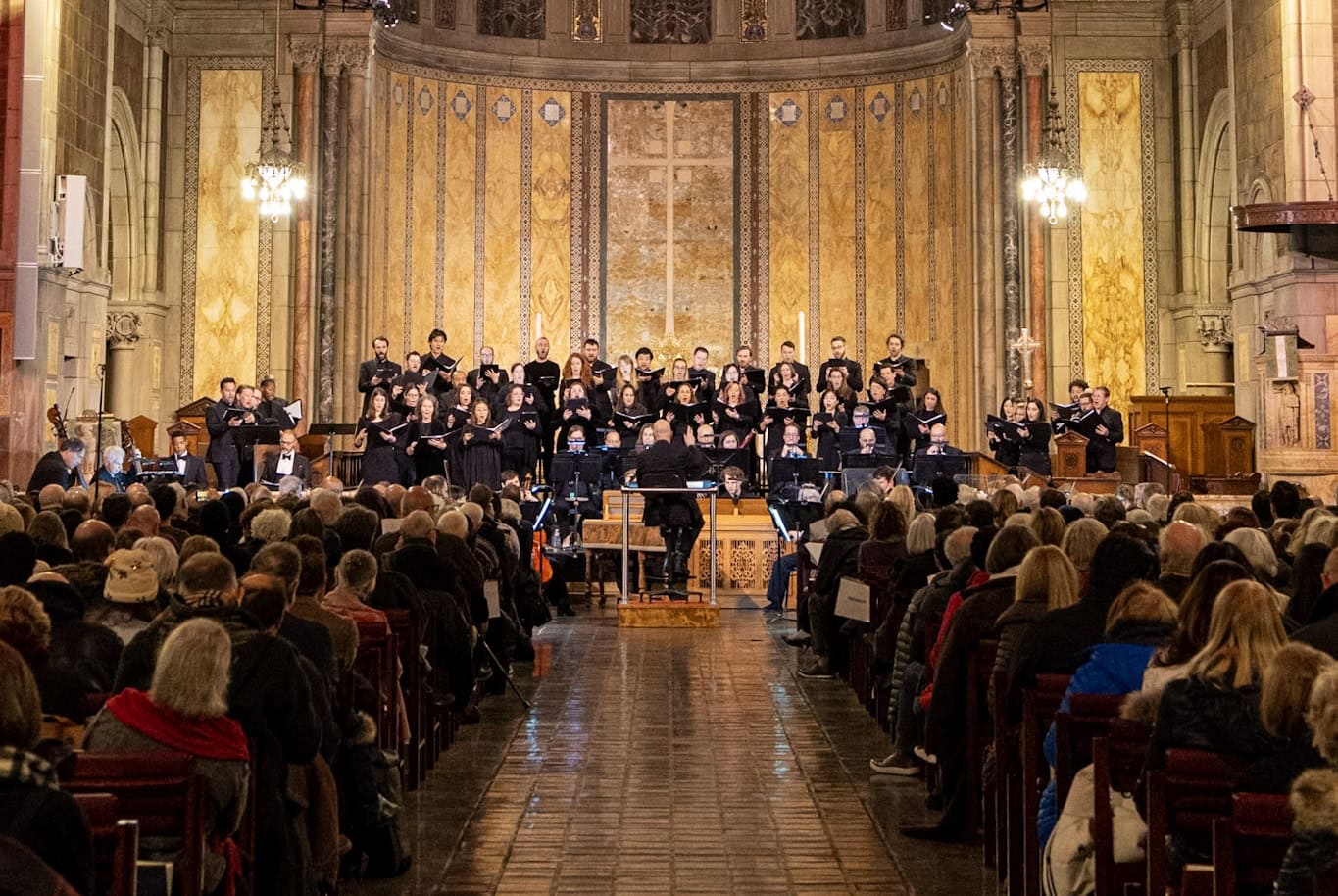
Requiem & Revelation
By Sonja Wermager
Peter Cornelius
Born December 24, 1824, in Mainz, Germany
Died October 26, 1874, in Mainz, Germany
Stabat Mater
Composed 1848-49
Premiered on August 11, 1929 in Salzburg, Austria
Conducted by Joseph Messner
Performance Time: Approximately 43 minutes
In 1906 a columnist for The Musical Times lamented that Peter Cornelius’s life was “the usual story of a genius-gifted composer’s struggle for recognition which refused to come.” During his fascinating life distinguished by association with some of the titans of nineteenth-century European musical culture, Cornelius was a valued colleague, supporter, and friend. Yet he never achieved the fame of those friends and associates like Wagner, Berlioz, and Liszt. Tonight’s United States premiere of his Stabat Mater for soloists, chorus, and orchestra provides a rare and welcome opportunity to hear this “genius-gifted composer.”
Cornelius was born in the city of Mainz, present-day Germany, in 1824. Born to two actors, Cornelius was trained from a young age to be both a musician and actor. He spent much of his early life in Mainz theaters, either playing violin in the orchestra pit or performing onstage. In many ways, this training prefigured his years-later declaration that “my life revolves around two poles: word and sound.”
This commitment to the marriage of word and sound is evident in the Stabat Mater, which Cornelius composed in 1848 and 1849 while studying in Berlin. The composition marked the pinnacle of his studies with teacher Siegfried Dehn, for whom sacred polyphony represented the highest level of compositional study. To support his student’s training, Dehn gave Cornelius a copy of Luigi Cherubini’s 1835 treatise on polyphony, “weeping.” Yet Cornelius does not risk monotony. Responding sensitively to the text, he uses a rich harmonic palette to explore glimmers of hope, perhaps reminding his listeners that within the theological world of the text, the Crucifixion is only the beginning of a story that ends in resurrection and salvation.
Another highlight is an especially expressive soprano solo in “Eja Mater.” Poetically, this marks a transition in the text from the thirdperson descriptive sections of the poem (i.e. “the sorrowful mother was standing”) to a first-person plea to the Virgin (i.e. “Come now, O mother”). To fully emphasize this shift to the personal, Cornelius uses an individual voice, the soprano soloist, who addresses the Virgin with a moving simplicity and sincerity.
The following movement, Sancta Mater expands her prayer from the individual to the collective: a chorus of a cappella voices. Cornelius returns to this a cappella scoring in the final two movements, as well. The sound of voices without instrumental accompaniment recalls the style of Renaissance masters like Giovanni Pierluigi da Palestrina (1525-1594). Indeed, during the month that Cornelius was intently working on the Stabat Mater, he was also reading a biography of Palestrina and copying out his music, at Dehn’s suggestion. Cornelius quipped that in transcribing Palestrina’s music, he was “nourished on good examples.” In these a cappella sections of the Stabat Mater, it is as if Cornelius is giving a characteristically generous nod of acknowledgement to those composers who set the text before him.
Luigi Cherubini
Born September 14, 1760, in Florence, Italy
Died March 15, 1842, in Paris, France
Requiem in C minor
Composed 1816
Premiered on January 21, 1817 in Paris, France
Conducted by Charles-Henri Plantade
Performance Time: Approximately 47 minutes
Those who insist that art should rise above the fray of politics would do well to look at the life and career of Luigi Cherubini. A
central figure in French musical life from the Revolution to the Restoration, Cherubini successfully weathered the seismic shifts of French politics by continually providing music to meet the moment. His Requiem in C minor is a remarkable case in point.
Although born in Florence, Cherubini lived most of his life in Paris. He first moved there in 1786, quickly finding success through his political savvy as much as his compositional talent. Cherubini gained entrance to the musical circle of Marie Antoinette and won the financial backing of Louis XVI’s brother (later, Louis XVIII) to launch an Italian opera company. In mid-1789, however, the political landscape transformed dramatically with the start of the French Revolution; Cherubini wisely scrapped a planned opera about royal heroism. In 1794 he became a naturalized French citizen and joined the Garde Nationale, providing music for political festivals. It was in this capacity that he led musical festivities at a 1796 celebration to commemorate the execution of the former king, three years prior.
Fast forward 20 years to 1816, when Cherubini was commissioned once again to commemorate the execution of Louis XVI: this time not to celebrate, but to mourn. After the upheaval of Napoleonic rule, which Cherubini navigated with characteristic political survivorship, he was appointed superintendent of the Royal Chapel by the restored Bourbon King Louis XVIII. In this role Cherubini produced a wealth of sacred music; in fact, from 1816 to 1822 he devoted himself to the genre almost exclusively.
The Requiem in C minor was composed for a solemn public event on January 21, 1817: the re-entombment of the French monarchs
whose remains had been removed from the Basilica of Saint-Denis during the Revolution. Cherubini’s setting of the Requiem, the Mass for the Dead in the Catholic tradition, sets an appropriate mood. The Introitus begins in the depths: Cherubini opts for low-pitched instruments—bassoons and cellos—that play THE ARTISTS a tentatively rising melody in unison. Violas join as the choir enters, hushed, singing the opening words of the Requiem text in a somber rhythmic lockstep. These words, “Give them eternal rest, O Lord” must have been particularly poignant at the first performance, with all present aware that the eternal rest of the French royals had been disrupted not long ago.
Later in the movement, the anguished harmonies of “exaudi orationem meam” (“hear my prayer”) give way to a musical ray of light:
Cherubini unexpectedly shifts to the major mode for “ad Te omnis caro veniet” (“unto Thee shall all flesh come”), as if to gently remind that these words are a promise, not a threat. The French composer Hector Berlioz, later a student of Cherubini’s at the Conservatoire, praised the older composer for this kind of “chiaroscuro,” or extreme contrast between light and dark.
The middle movements of the Requiem emerge from the gloom. Listen for the violins, suddenly shimmering high in the register, that herald the Archangel Michael and his holy light. Note also how God’s promise to Abraham and his heirs, repeated in an extended section of cascading polyphony, evokes the patriarch’s numberless descendants.
The Sanctus is likewise celebratory. But the sense of triumph is temporary. In the final two movements, Cherubini brings us back to the sobriety with which the work began. The Pie Jesu is characterized by a motive that reaches upwards before falling chromatically back down the scale, allowing Cherubini to play once again with the dividing line between major and minor.
The Agnus Dei oscillates between pianissimo and sudden flashes of forte, punctuated by dotted rhythms reminiscent of French tragic
opera. These outbursts, however, eventually subside and the music begins a slow fade to the end. In a remarkable compositional choice,
Cherubini pares back to choral monotone for the final two lines of text (which are also the first two lines of text). Of this ending Berlioz wrote: “It is the gradual decline of a suffering being, we see it fading and dying, we hear it expire….The Agnus in decrescendo surpasses everything that has ever been written of the kind.”