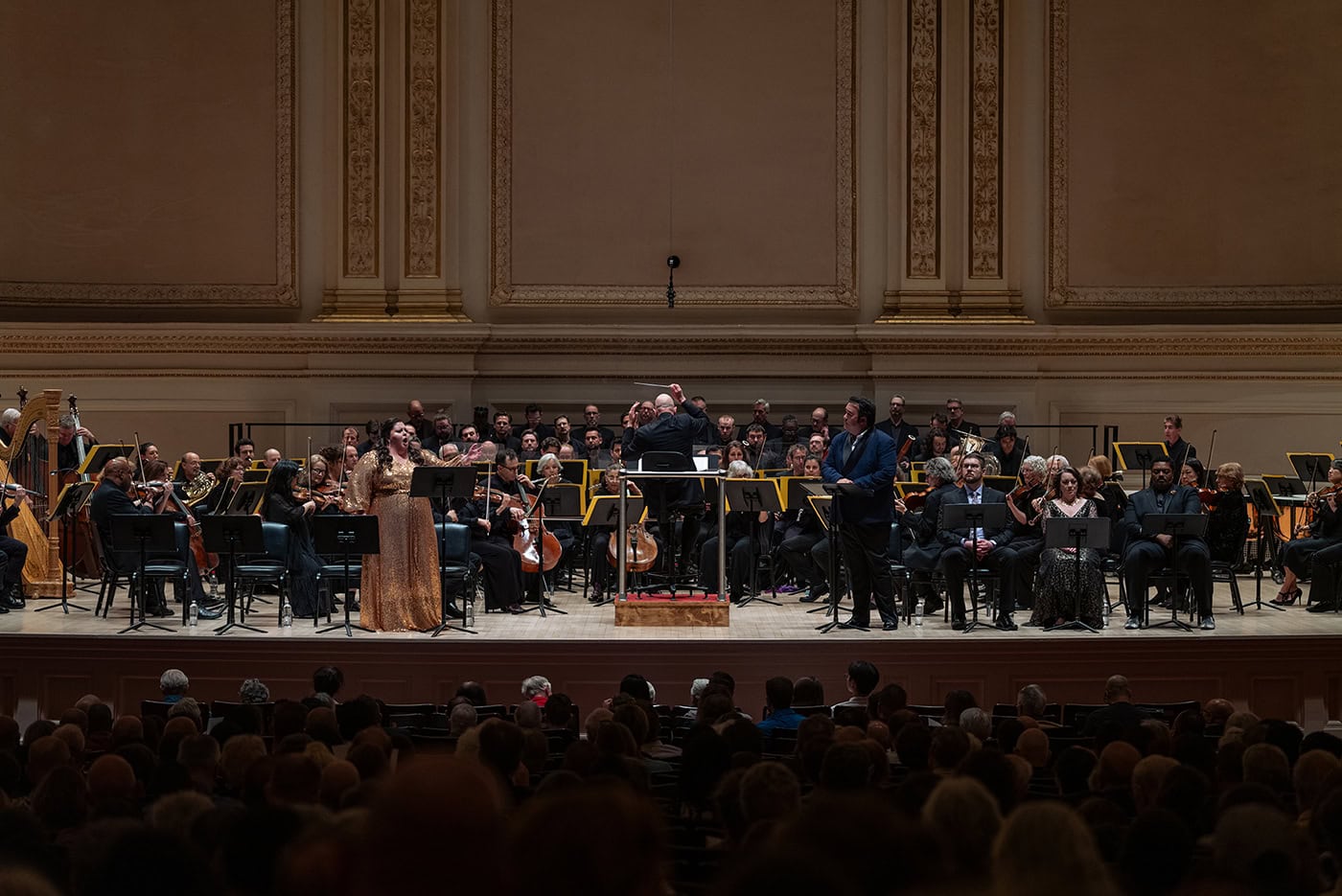
Weber & Berlioz: Der Freischütz Reimagined
By Leon Botstein
The first performance of Carl Maria von Weber’s Der Freischütz in Berlin, on June 18, 1821, was one of the most memorable first performances in the history of music in the 19th and 20th centuries; it can be properly compared to the Paris premiere of Stravinsky’s ballet, The Rite of Spring, in 1913. In Berlin, the opera made a profound and lasting impression on the 12-year-old Felix Mendelssohn. Der Freischütz went on to be performed in every major city in Europe. It was a smashing success everywhere, but especially in Vienna. It won the admiration of the young Schubert and earned the grudging respect of the venerable and revered Beethoven, with whom Weber had an ambivalent and shifting relationship that ranged from Weber’s initial disapproval to later admiration.
As Beethoven knew, from his own experience, success as a composer usually required writing operas that captured the imagination of the public. Even composers who failed in this genre—like Robert Schumann—or only fantasized about writing an opera—like Chopin—knew that opera, and spectacle and tunes, represented the shortest distance to fame and fortune for a composer. Many names now forgotten from the early 19th century, including Étienne-Nicolas Méhul (1763–1817), Gaspare Spontini (1774– 1851), Louis Spohr (1784–1859), and Giacomo Meyerbeer (1791–1864), were international celebrities, alongside Gioachino Rossini (1792–1868), as a result of their operas. Rossini’s popularity became so intense that it annoyed Beethoven during the last years of his life. The pattern was set by Gluck and Mozart. Haydn turned out to be an exception, but he, too, excelled at dramatic music, and wrote a good number of operas filled with spectacular music, but without the exceptional instinct for drama he knew Mozart had.
We think of Weber as a significant figure in the history of German Romanticism, which he was, even though he died just months short of his 40th birthday in 1826, a year before Beethoven, and two years before Schubert. We need, however, to remember that Romanticism had made its appearance already in literature and the theater in the 1770s, with its turn away from Classicism towards forms of prose realism and poetic fantasy.
The expressive range of the melodies, the pacing of the drama, the use of chorus, and the narrative vibrancy and tension of the score all made Der Freischütz a landmark of a new aesthetic freedom that privileged, in the form of opera, subjectivity and ordinary human domestic and Romantic predicaments in an old feudal context, and not history dominated by myths and heroic, if not saintly, figures set in predictable formal structures. When it was first performed, Der Freischütz sounded new and original. It heralded the flowering of a German musical Romanticism that dominated in the 19th century and that retained an allegiance to the classical procedures in the composition of music.
Its story has many of the key elements of the German literary and philosophical reaction against the conceits of the so-called “Age of Reason.” This was inherited from the 18th century, whose optimism about the role of rationality as the governing force in human behavior and politics was shattered by the history of the French Revolution, notably the Reign of Terror, and the rise to power of Napoleon and his conquest of Europe. The defeat of Prussia at the Battle of Jena in 1806 by the French sparked German national sentiment and a solidarity that would dominate Germanspeaking Europe well into the 20th century.
But the nascent nationalism of the first half of the 19th century did not wreck the perception of music as an international art form that defied linguistic and political boundaries, even though the story and libretto of Der Freischütz (in contrast to Weber’s less successful but magisterial Euryanthe) had many characteristics shared by German Romantic literature and painting. It possesses a fascination with the supernatural, magic, the forest, darkness, fairy tales, and pre-modern mores dating to the early 17th century but rooted in medieval and feudal times. The distinctly Germanic character did not prevent the opera from delighting non-German audiences, including the French in Paris in the 1820s (much as Wagner would later, after 1870, despite France’s defeat at the hands of the Germans, led by Prussia, in 1871).
The success of Weber’s most famous opera lay, therefore, in the music and not the text. Weber’s music makes one ignore the pedestrian writing in the libretto by framing the story as a drama that would be defined, from the very first arresting notes of the overture, by music. Weber retained the German tradition of spoken dialogue, a feature of the Singspiel (consider Mozart’s The Magic Flute and The Abduction from the Seraglio, and Beethoven’s Fidelio). Weber’s engaging use of harmony and key themes, his sense of pacing and dramatic contrast, his masterful deployment of the sonorities of the orchestra, and use of the chorus, consistently foreground music as the key element of the theatrical experience. The brilliance and immediate appeal of the music, and its capacity to convey the visual and emotional dimensions of the story, were startling and did not suffer when the opera was translated from the original German.
Weber has remained an underappreciated composer, particularly outside of German-speaking Europe. Too little of his instrumental music is played—piano music, concertos (apart from the two clarinet concertos), and symphonies. His place in music history rests on his operas (including Gustav Mahler’s completion of Die drei Pintos from fragments left behind at Weber’s death). Der Freischütz, as Richard Wagner freely admitted, was a milestone in the development of his vision of the music drama and the “total work of art.” The Flying Dutchman, Lohengrin, and Tannhäuser all stem from the example set by Weber’s masterpiece.
Der Freischütz was a staple in the repertoire of the Metropolitan Opera during the late 19th century through to the early 20th. It was especially popular within the large German-American community of New York City. Excerpts for chorus and solo voices, as well as the overture, were extremely familiar to music lovers throughout America in the 19th century. The massive immigration from German-speaking Europe to America after 1848 led to the dominance of the German musical tradition in the evolution of an American classical music culture at the end of the century. That remained the case until 1917, when the US entered World War I. However, Der Freischütz has retained its popularity in German-speaking Europe, between 1918 and 1933, especially during the years of Nazi rule, and after 1945, both in West and East Germany. It has functioned as a work of musical theater through which competing and often critical ideas about German cultural and national identity could be articulated.
Two world wars, however, took their toll, not, ironically, on the popularity of Wagner, but certainly on Weber in America. In the case of Der Freischütz, the problem was its distinctly German non-heroic domestic context and storyline. Even translating the title poses a problem. The ritual alluded to is obscure and hard to translate. And none of the characters, even Agathe and Ännchen [Annette in the version presented this evening], the lead female characters, are particularly personalities with whom it is hard to identify. The mystery of the magic bullets and the Wolf’s Glen are rooted in rural traditions and superstitions that have few, if any, persuasive modern equivalents.
This makes the greatness of the music even more impressive. It is unforgettably beautiful, arrestingly dramatic, and easy to absorb. It never descends into kitsch and yet is consistently alluring. Furthermore, the supernatural aspects and the mix of emotional realism, including residues of pagan beliefs, magic, and Christian concepts of salvation, redemption, and forgiveness, lend the opera qualities that have been exploited in recent decades in popular feature films and series. Perhaps Der Freischütz will get a new lease on life courtesy of Game of Thrones and all the Netflix-type series that draw on pre-modern history, such as the Vikings and the early history of England.
As Samuel Nemeth, in his fine notes for this performance has eloquently pointed out, Hector Berlioz, the brilliant, iconoclastic innovator— and perhaps the finest prose writer who was at the same time a great musician—was captivated by Weber’s score and its originality. A formidable newspaper critic who helped propel the music of Beethoven into the consciousness of the French public, Berlioz was outraged by the many popular bowdlerizations and disfigurations of the operas of the great masters on the Parisian stage. The 1824 French version of Der Freischütz particularly offended him.
It is well to remember that before 1848, nationalist sentiments had not become so strident as to shatter a long international appreciation of the instrumental and operatic repertoire that flourished throughout Europe. Berlioz’s reputation as a composer was made as much in German-speaking Europe as in France. He triumphed also in Russia and England. Operas originally in one language were routinely performed in the language of the audiences for which they were being performed. Mozart’s Italian operas, for example, for German audiences were produced in German. Berlioz’s admiration for Weber’s opera led him to make a French version that respected Weber’s music and drama and would draw an audience. He succeeded.
Berlioz, however, did not resist the temptation to update Weber’s opera, 20 years after its premiere. He replaced the spoken dialogue with recitatives he himself composed, giving the opera a continuous musical fabric. And he inserted his own orchestration of Weber’s Invitation to the Dance, a work for piano Weber had written in 1819. The creation of this separate dance episode catapulted Weber’s piano work into the standard repertoire of orchestras, owing to Berlioz’s superlative orchestration. When one compares Weber’s 1821 Der Freischütz with Berlioz’s 1830 “Fantastic” Symphony, one can appreciate Berlioz’s enthusiasm for Weber.
We have been accustomed to claims of authenticity and faithfulness to the text and a composer’s intentions. Consequently, we frown on alterations, cuts, re-orchestrations, and the use of modern performance practices. Yet there are several notable examples when revisions and adaptations may improve on the “original.” Or, if not, they compete with the original, as in the case of Ravel’s orchestration of Mussorgsky’s Pictures at an Exhibition. It is reasonable to speculate that Berlioz’s decision to replace dialogue with recitative and insert Weber’s Invitation, and create a version in French, may improve Weber’s opera and soften its association with a particular nationalism, lending this great work the humanity and universalism that its music communicates, and deepening its appeal.