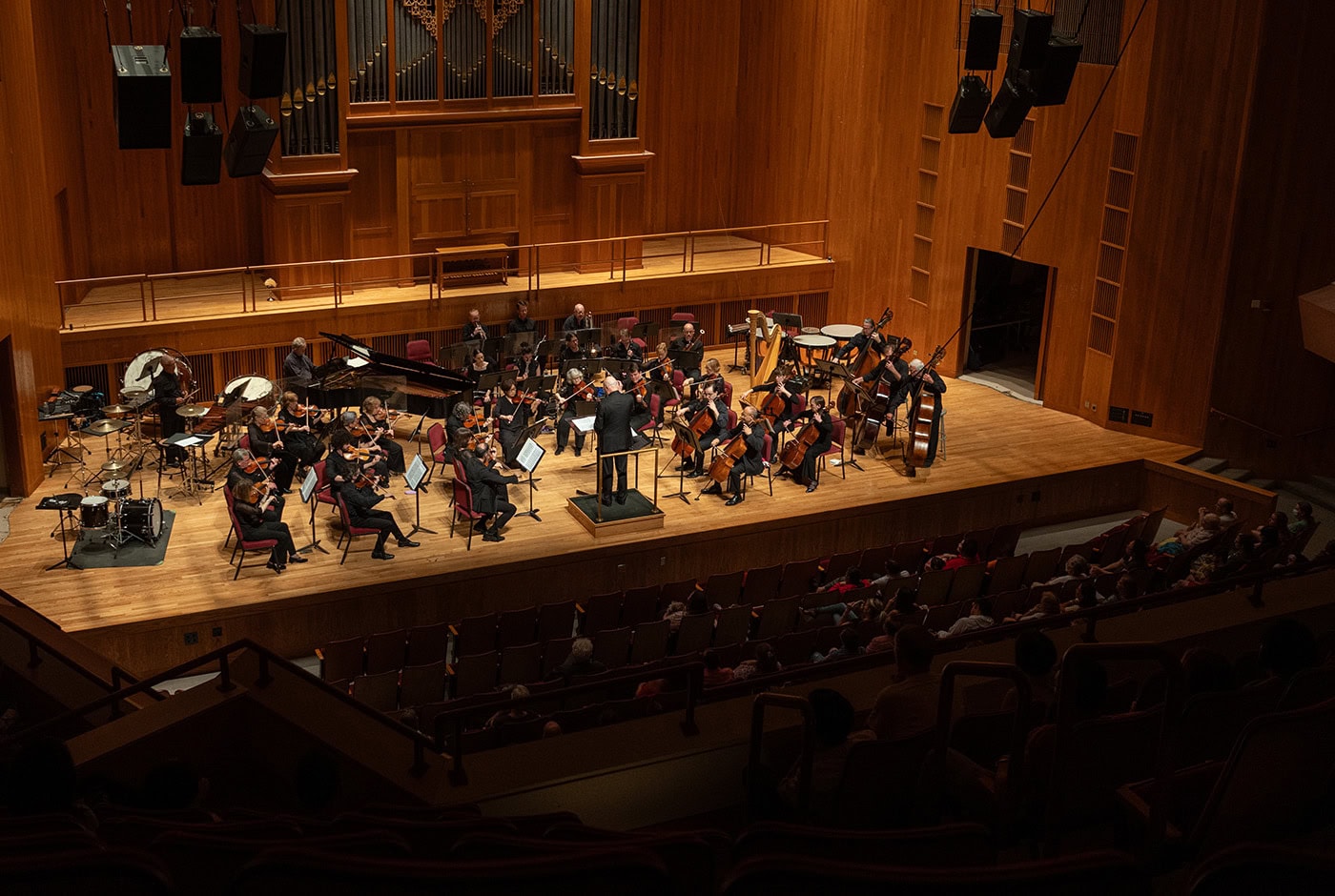
New York Resounds
By Sebastian Danila
Aaron Copland
Fanfare for the Common Man
Born November 14th, 1900, in Brooklyn, NY
Died December 2nd, 1990, in Sleepy Hollow, NY
Composed 1942
Premiered in 1943 in Cincinnati, OH
Conducted by Eugene Goossens
Performance Time: Approximately 3 minutes
Few compositions have entered the American consciousness as thoroughly as Aaron Copland’s Fanfare for the Common Man. Undoubtedly his most famous work, its unmistakable opening theme has taken on a life far beyond the concert hall. It has appeared in television programs, advertisements, Hollywood films, and political campaigns; been heard at countless funerals and memorial services; and even accompanied the Space Shuttle Endeavour as it touched down at LAX following its final flight. The Fanfare has also inspired arrangements by musicians across the musical spectrum, from jazz composer and bandleader Woody Herman to the progressive rock group Emerson, Lake & Palmer, while the Rolling Stones famously used its opening as entrance music during one of their tours.
In response to the United States’ entry into World War II and with the aim of rallying the American people at a crucial moment in the country’s history, Eugene Goossens and the Cincinnati Symphony Orchestra invited ten prominent American composers in 1942 to contribute a fanfare for performance at the opening of each concert during the orchestra’s 1942–43 season. Among those commissioned were Howard Hanson, Henry Cowell, Virgil Thomson, Walter Piston, and Aaron Copland. While several composers chose explicitly patriotic or military subjects, with titles such as A Fanfare for Paratroopers, A Fanfare for Freedom, and A Fanfare for American Heroes, Copland’s contribution immediately stood out to Goossens. “Its title is as original as its music,” he wrote to the composer. In fact, Copland had struggled to find an appropriate title, at one point considering Fanfare for the Spirit of Democracy. He ultimately settled on Fanfare for the Common Man, later explaining: “It was the common man, after all, who was doing all the dirty work in the war and the army. He deserved a fanfare.” The title thus captures the work’s essential message: a tribute not to military leaders or grand victories, but to the ordinary men and women whose courage and sacrifice sustained the nation.
Marked “Very deliberate,” the Fanfare opens with a brief, almost ferocious percussion introduction, punctuated by emphatic silences, before the trumpets enter in unison with a bold, expansive theme. Broad ascending and descending leaps, built largely from triadic harmonies, lend the melodic line its unmistakable character. Copland’s use of silence between phrases is particularly striking, giving each statement a sense of weight and inevitability. As the fanfare progresses, the texture gradually expands and the harmonic sonority becomes richer, culminating in a full-brass proclamation of the principal idea. With the entire ensemble now participating, pungent modal and chromatic shifts transform the harmonic language, propelling the music toward a remote key and bringing the work to a powerful conclusion. Declamatory without being bombastic, solemn yet deeply affirmative, the music speaks with extraordinary simplicity and directness, conveying a non-militant message of dignity, unity, and shared purpose.
George Walker
Lyric for Strings
Born June 27th, 1922, in Washington, D.C.
Died August 23rd, 2018, in Montclair, NJ
Composed 1946
Premiered in 1946 in Philadelphia, PA
Conducted by Seymour Lipkin
Performance Time: Approximately 6 minutes
In the course of his long life, composer and pianist George Walker had a trailblazing career that was marked by numerous “firsts”: he was the first Black graduate of the Curtis Institute of Music; the first Black pianist to give a recital at the Town Hall in New York, to appear as soloist with the Philadelphia Orchestra (all in 1945), and to tour Europe under the aegis of National Concert Artists (1954), and the first Black recipient of the Pulitzer Prize in Music (1996).
Born in Washington, D.C., into a middle-class family that strongly supported and appreciated music, Walker began studying piano at the age of five. At just 15, he entered Oberlin Conservatory, and upon graduating in 1941, continued his studies at Curtis, where he studied composition with Rosario Scalero and piano with Rudolf Serkin. Following doctoral studies at the Eastman School of Music, he went to Paris in 1957 to study with Nadia Boulanger under a Fulbright fellowship. Walker taught at a number of institutions, including the Dalcroze School of Music, the New School, Smith College, the University of Colorado, the Peabody Institute, and Rutgers University, where he chaired the music department. He composed more than 100 works, spanning chamber music, choral music, solo piano, and orchestral repertoire. The recipient of numerous awards and honors, Walker was awarded the 1996 Pulitzer Prize in Music for Lilacs for voice and orchestra, based on a poem by Walt Whitman and premiered by the Boston Symphony Orchestra.
Lyric for Strings is arguably Walker’s finest achievement. The work began as the second movement of his String Quartet No. 1, composed in 1946 after his graduation from Curtis and dedicated to his grandmother, Malvina King, who had recently died. Initially titled Lament, the work was arranged for string orchestra and premiered by Seymour Lipkin and Curtis’s student orchestra. Walker subsequently titled it Adagio, before finally settling on Lyric since, explaining that the latter “more aptly described the character of the work.” Often compared to Barber’s celebrated Adagio for Strings, Walker’s piece draws its inspiration instead from the slow movement of Beethoven’s String Quartet in F major, Op. 135, a work he greatly admired. Following a brief introduction of falling gestures and sustained tones that evoke a mournful mood, the principal theme emerges in the violins and gradually permeates the entire ensemble, passing through the other string sections in imitation. These exquisite contrapuntal textures eventually yield to a static interlude of softer, homophonic chords, providing a moment of quiet contemplation. The principal idea then returns in increasingly animated statements, intertwining contrapuntally and building toward an impassioned climax. The gentler harmonies reappear to temper the intensity, as progressively embellished versions of the theme unfold in moments of unrestrained lyricism. In the coda, the quiet chords return once more, revealing their important structural role in the work and bringing this hauntingly beautiful piece to a close with a sense of ineffable serenity.
Charles Ives
The Gong on the Hook and Ladder
Born October 20th, 1874, in Danbury, CT
Died May 19th, 1954, in New York, NY
Composed 1911
Premiered in 1934 in New York, NY
Conducted by Albert Stoessel
Performance Time: Approximately 3 minutes
Charles Ives occupies a singular place in the history of American music. A native of Danbury, Connecticut, he combined composition with a successful career in the insurance business. His works, many of them unpublished and unperformed during his lifetime, anticipated some of the most radical developments in twentieth-century music: polyrhythm and polytonality, free dissonance, and even aleatoric techniques. For more than a decade at the beginning of the century, he experimented with collages of sound, rhythm and juxtaposed metric patterns in brief chamber works which he called “sets” or “cartoons.”
One such work is The Gong on the Hook and Ladder, subtitled Firemen’s Parade on Main Street. Conceived around 1911 for piano and strings, with an optional fire bell, it was later arranged for small orchestra before 1934. This piece is a playful experiment in seemingly irrational metric and rhythmic clusters, humorously depicting the regular ringing of the fire bell and the fluctuating speed of the fire wagon as it makes its way along Main Street in Danbury. As Ives described it:
… another nice joke, which most everybody can see… The Annual Parade of the neighborhood Volunteer Fire Company was a slow marching affair—for the Hook and Ladder was heavy, the Gong on the hind wheel ‘must ring steady-like’—and coming downhill and holding backward fast, and going uphill out of step, fast and slow, the Gong seemed sometimes out of step with the Band, and sometimes the Band out of step with the Gong—but the Gong usually got the best of it. Nobody always seemed to “keep step,” but they got there just the same…
Written in an unusual 7/8 meter that is almost imperceptible amid the ensuing cacophony, the piece also incorporates quotations from three popular American songs—Marching through Georgia, Oh My Darling, Clementine and Few Days—musical quotation being another hallmark of Ives’s musical language. As the parade progresses, these familiar tunes emerge in quick succession, each adding to the mounting excitement until the music reaches a powerful climax. The opening music then returns, before the entire scene gradually recedes into silence.
Joseph Haydn
Symphony No. 44 in E minor, “Trauersinfonie” (Mourning Symphony)
Born March 31st, 1732, in Rohrau, Austria
Died May 31st, 1809, in Vienna, Austria
Composed 1772
Premiere information unknown
Performance Time: Approximately 22 minutes
Between roughly 1768 and 1772, Joseph Haydn’s music underwent a far-reaching transformation, as his style turned toward works that were darker, more intense, more personal, and more emotionally charged than anything he had written before. So profound was this change that many music historians have associated this period with Sturm und Drang (“storm and stress”), a movement then in vogue in German literature and the other arts. Rejecting the rationalism of the Enlightenment and the elegance of the style galant, Sturm und Drang instead embraced tormented, gloomy, and extreme emotions, while exploring the macabre and the fantastic and evoking feelings of fear and terror. Haydn’s compositions from this time are characterized by sharp shifts of mood and character, heightened harmonic tension, driving contrapuntal textures, extreme dynamic contrasts, dramatic silences and pauses, and turbulent, restless rhythmic writing. Many are also in minor keys; in fact, Haydn wrote more minor-key pieces during these years than at any other time in his career. Few works exemplify these characteristics more strikingly than his Symphony No. 44 in E minor.
Composed around 1771, this symphony acquired the nickname “Trauer” (“Mourning”) from a possibly apocryphal story that Haydn expressed a wish for its Adagio movement to be played at his funeral. It was indeed performed at a memorial service in November 1809, a few months after his death, an event that may have contributed to the legend. Marked Allegro con brio, the first movement opens with a brief but powerful unison motive that rises an octave through a fifth and fourth, followed by a descending “sighing” figure, echoed after brief pauses in hushed tones. The plaintive melody that follows does little to dispel the sense of urgency, as the opening motive soon returns in a forceful double statement of the principal theme. Although the movement unfolds through a variety of contrasting phrases and accompanying patterns, the opening motive remains a vital presence throughout. It also provides the foundation for the second theme, appearing first in the bass and then, only a few measures later, rising dramatically through three octaves. The development becomes still more turbulent, subjecting sequential figures derived from earlier material to increasingly frenzied treatment over equally unsettling syncopated rhythms. A condensed recapitulation leads to a fermata, after which the main motive makes one final appearance, now in hushed, overlapping contrapuntal imitation, building to a conclusion of ferocious intensity.
In a highly unconventional move, the Menuetto is placed second in this symphony, Haydn thus shifting the center of gravity toward the slow movement. Equally unusual is the strict counterpoint employed here: the entire Minuet is a canon at the octave (Canone in Diapason, as Haydn marked it) between the outer voices at the interval of three beats, with the remaining voices acting as passive protagonists in free imitation. The tonic key remains in E minor, yet the mood feels somewhat lighter than in the preceding movement. The central Trio section is even more lyrical, in the contrasting parallel key of E major, providing relief from the somber, dark-hued sonorities present in this piece. Noticeable here is the use of the solo horn to double the melody of the first violins, an orchestrational masterstroke.
The Adagio that follows is in the key of E major, the same key of the Trio in the preceding movement, as though anticipating its arrival. It is a movement of ethereal beauty, providing a striking contrast to the dark, brooding character of the rest of the symphony. The muted violins unfold in shimmering lines, their soaring leaps infused with an extraordinary lyricism, while the winds enter at crucial moments in understated tones, adding gentle touches of warmth and color. The result is a deeply poignant meditation, at once sorrowful and consoling, amongst the most moving passages Haydn ever wrote. It is therefore not surprising that, if the story is true, Haydn chose this particular movement to be played at his funeral in his final years; few works could have offered a more fitting farewell.
Back in the home key of E minor, the Finale is propelled by a relentless emotional drive unlike anything Haydn had brought to a concluding movement before. As in the first movement, it opens with a unison statement punctuated by forceful rhythmic gestures and sudden silences, creating an immediate sense of urgency. Written in an essentially monothematic sonata form, the opening few notes determine the melodic content of the entire movement. As the tension mounts, the texture grows increasingly contrapuntal, culminating in a double-canonic treatment of the principal theme. The development proceeds through a steadily ascending sequence derived from the same idea, repeated insistently until it builds to a tremendous climax. Remarkably, Haydn avoids a straightforward return of the principal theme in the recapitulation; instead, we hear only fragmented versions of it, combined with a reprise of the double canon and an intensification of rhythmic instability. Not until the coda does the main theme return in recognizable form, and even then only in the bass, while the other voices combine breathlessly around it to bring this stormy movement to a stunning conclusion. Here Haydn stands at the height of his compositional maturity, displaying an extraordinary command of contrapuntal technique and striking motivic concentration, with a terseness that drives the musical rhetoric to compelling effect.
Gustav Mahler, arr. Cliff Colnot
Adagio from Symphony No. 10 (arr. CLIFF COLNOT)
Born July 7th, 1860, in Kaliště, Czechia
Died May 18th, 1911, in Vienna, Austria
Composed 1910
Premiered in 1924 in Vienna, Austria
Conducted by Franz Schalk
Performance Time: Approximately 25 minutes
If Oscar Wilde’s dictum that “life imitates art” is correct, then the circumstances surrounding Gustav Mahler’s composition of his unfinished Symphony No. 10 are worthy of a novel by Flaubert or Henry James.
Alone at his summer retreat in Toblach, Mahler spent the early summer of 1910 working assiduously on his Tenth Symphony while simultaneously preparing for the premiere of his Eighth. Meanwhile, his much younger and beautiful wife, Alma, was recuperating at a spa near Graz following a period of severe emotional distress caused by Gustav’s difficult personality. There she met the young architect Walter Gropius, still years away from the distinguished career that would later make him famous, and the two embarked on an affair. Resentful of what she perceived as Mahler’s physical and emotional withdrawal, Alma continued the relationship with Gropius even after joining her husband in Toblach. The affair was exposed when Gropius inadvertently addressed a letter to “Herr Direktor Mahler” in which he implored Alma to leave Gustav. Deeply shaken by the discovery, Mahler traveled to Leiden, where Sigmund Freud was vacationing, and sought his counsel. Following their encounter, and after Alma decided not to leave her husband—although she carried on her liaison with Gropius—Mahler’s emotional condition improved sufficiently for him to resume work on the symphony.
As he continued working on the Tenth, Mahler covered the manuscript pages with anguished annotations reflecting the turmoil of this period, including such exclamations as “Madness, seize me, the accursed!” “Mercy!” and “To live for you! To die for you!” After returning to New York at the end of the summer, however, he appears to have abandoned the symphony. Alma remained at his side throughout his final illness, travelling with him from New York to Paris and ultimately to Vienna, where he died of a blood infection in May 1911.
Of the intended five movements for this symphony, most were only notated in a short score with the vocal lines and occasional indications of instrumentation. Only the first two movements and several measures of the third exist in orchestral draft. Of these, however, only the opening Adagio is sufficiently orchestrated to be performed in the concert hall without substantial additions. Numerous attempts have been made to complete the remaining four movements, the most prominent being that of Deryck Cooke, completed in 1964 and revised in 1976.
Although the movement is called “Adagio”—which tonight we shall hear in a chamber orchestra arrangement from 2008 by the late Cliff Colnot— it opens with a contemplative Andante: a harmonically ambiguous viola soliloquy in a quasi-recitative style. Soon the true Adagio begins with a warm (“warm” being Mahler’s own instruction), luxurious melody in F-sharp major, introduced by the violins, before extending to increasingly distant harmonic realms. Throughout the piece, Mahler develops these two contrasting ideas, gradually building toward a stunning climax: a terrifyingly dissonant nine-note chord that seems to give voice to his inner turmoil. Particularly striking is the fact that the tension begins to accumulate around a solitary, sustained A in the first violins, later taken up by the trumpet, while the nine-note chord is built up around it and then obsessively repeated. The prominent A has often been interpreted as a symbolic reference to the initial letter of Alma’s name. As the sound gradually recedes, fragments of the opening ideas return, leading to a gentle conclusion in which the falling melodic motion imparts a sense of calm, as the strings and winds seem to dissolve into an atmosphere of quiet serenity. We may never know with certainty Mahler’s true intentions—given his habit of revising his scores—but the Adagio is nevertheless a work of extraordinary sophistication, revealing elements of his austere late style while also pointing toward the emerging language of modernism.
Program notes by Sebastian Danila, Bard College